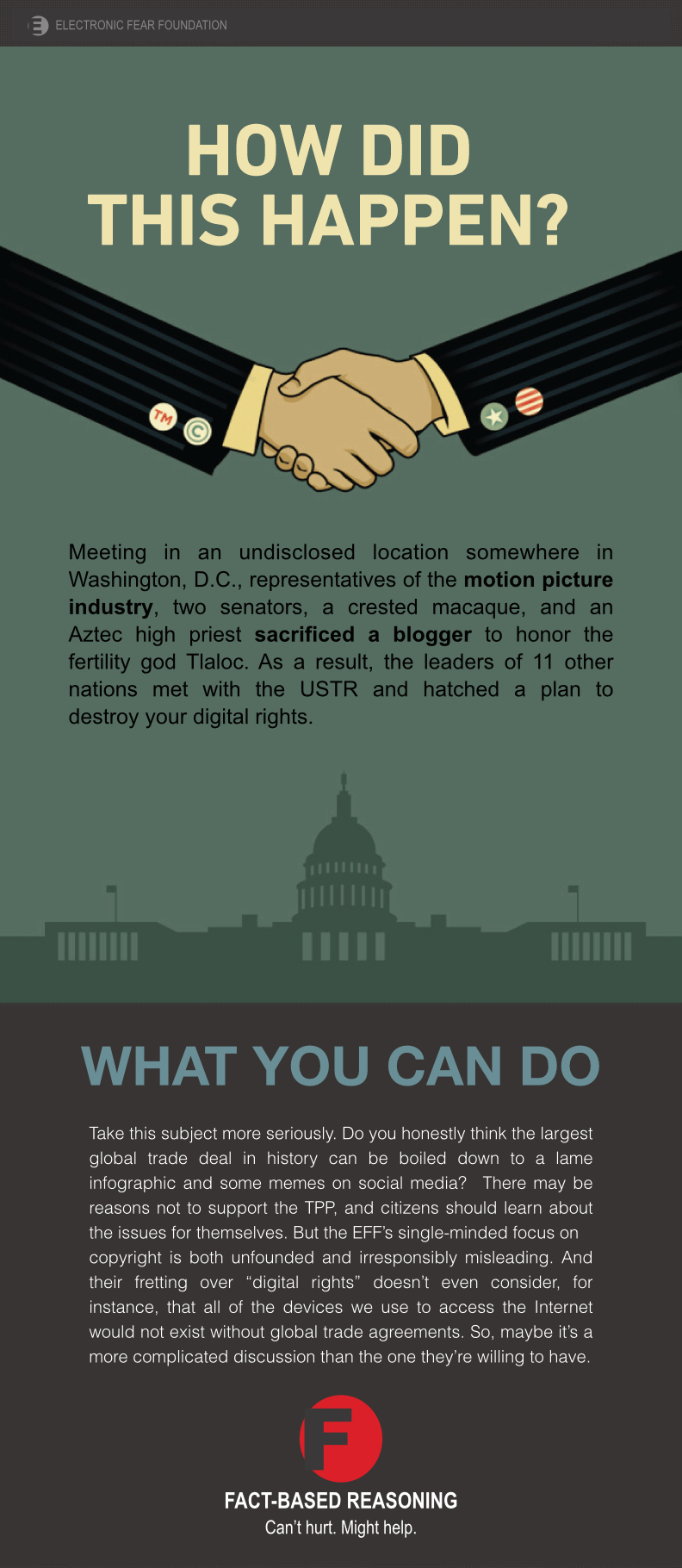
So, this week, the Electronic Frontier Foundation launched its new infographic (stress on graphic) still pitching the idea that it is the IP provisions in the Trans Pacific Partnership agreement that are of the gravest concern. The EFF states on their site that the infographics are covered by a Creative Commons license* and that anyone is free to use or remix the assets with attribution. So, with all due credit to the EFF for the original works, I have taken the liberty of remixing as suggested. And in the spirit of sharing, feel free to use these on social media with or without attribution.
Tag: TPP


Sarah Jeong Pitches Copyright Conspiracy Thriller

In what sounds like an homage to Tom Clancy, Sarah Jeong, a contributing editor to Motherboard, presents us with a cautionary action thriller in which the Chinese government could theoretically disappear one of the most famous and politically significant photographs ever taken. And all because of American copyright law. You know the photo. It’s the image that comes immediately to mind when you think of the 1989 Tiananmen Square protest—the still-unidentified young man who stood in front of a column of four Peoples Liberation Army tanks, taken by AP photographer Jeff Widener.
In her recent editorial, Jeong speculates that a Chinese company called Visual China Group may now own the copyright on the iconic image as the result of its purchase of a collection of works that had belonged to Bill Gates. Jeong states that she does not know if the Widener photo is among the works purchased—there are other “Tank Man” images—and she further mentions that VCG has entered into a licensing partnership with US-based Getty Images. Nevertheless, Jeong insists that her hypothetical censorship scenario is “not entirely implausible”, citing unpredictability of the Chinese government and proposing a scenario in which the photo may be widely removed from the Internet by means of DMCA takedown procedures. In asserting that this already multi-hypothetical circumstance would be entirely the fault of American copyright law, the deus ex machina in Jeong’s plot hinges on the following supposition:
“As owners of the copyright to the photo, Visual China Group could easily launch a massive censorship campaign across the internet. The group only needs to send a notice under the DMCA to upstream service providers that host the Tank Man photo—Google, WordPress, Amazon Web Services, Wikimedia, Facebook. If a DMCA notice is valid, a service is required by the law to take down infringing content—or else it can become liable for copyright infringement.”
Of course, nothing she describes reflects an accurate portrayal of how DMCA works, even if Chinese authorities did currently have their hooks into this particular photo. As rights holders know all too well, an individual notice must be sent in regard to each alleged infringement. One may not simply send a blanket notice to WordPress and say, “Take this off every WP blog.” Then, as explained in considerable detail in my last post, the counter notice is still the final word under DMCA provisions, after which the rights holder must litigate in order to pursue removal. But apparently undaunted by her basic misunderstanding of this aspect of copyright law, Jeong presses on with the following:
“Although fair use could cover use of the photo, thus giving a service provider an excuse not to honor the DMCA notice, that’s by no means a certain defense. See, for example, Fox News’ legal troubles over a copyrighted photograph of firefighters on September 11th—although the news organization cited fair use, a judge denied its motion for summary judgment on the issue, and Fox News ultimately settled the issue out of court.”
It’s a little hard to tell if Ms. Jeong is writing carelessly here or simply doesn’t understand the safe harbor provisions in the DMCA, but nobody should be confused into thinking that it would be the OSPs like Google, WordPress, et al who would be asserting any kind of fair use defense in a theoretical infringement claim of this nature. It’s the individual uploader of the material who is the actual recipient of a takedown request processed through the OSP, and it is he or she who may decide to argue that the use is non-infringing. The safe harbor shielding OSPs is predicated on the idea that they don’t see nothin’, they don’t know nothin’, and they don’t say nothin’ ‘bout no infringements by its users.
To make matters…worse? Stranger? Sillier? I don’t know. Jeong randomly points to a case in which Fox News’s motion for summary judgment based on a weak fair use claim was appropriately rejected by a district judge; and she cites the example as if this one case is evidence that fair use defenses just don’t work. Well, tell that to the same Fox News, which has thus far lost to TVEyes on the latter’s somewhat questionable fair use defense. But as long as Jeong is already wet, she dives all the way into the deep end with this inscrutable speculation:
Journalistic usage of the Tank Man’s photos—which persist in newsworthiness and historical value for the public—should be obviously covered under fair use, but the actual copyright analysis isn’t much different from the Fox News lawsuit. And if that’s the case, perhaps copyright law is broken.
It is possible, of course, that Ms. Jeong doesn’t realize that news networks, photojournalists, reporters, etc. are all copyright holders and that these folks do not make a habit of poaching one another’s intellectual property on the grounds that they are doing the noble work of reporting the news. (This would be rather circular logic for infringement of journalism.) But for sure, she either did not read—or does not remotely understand—the facts in the Fox News case to which she refers because the network’s fair use defense in that instance hinged on its argument that its use of North Jersey Media Group’s image on its Facebook page was “transformative” simply because it was hosted on a social media platform.
Perhaps one day a court will agree with a TV network or General Motors or Pfizer that its Facebook page is indeed a little haven of fair use, at which point we can ball up the fair use doctrine and toss it in the fire. But for now, it is nearly impossible to imagine whence Jeong conjures the idea that her tens of thousands of hypothetical conflicts over the Widener image might each resemble the “analysis” applied in this one Fox News case. In fact, I’m not sure the district judge analyzed the fair use argument all that carefully so much as he just summarily called “bullshit” on it.
Naturally, the subplot in this Sino-censorship-via-American-copyright story is the implication that passage of the Trans Pacific Partnership will make matters worse by way of exporting DMCA-like procedures to US trading partners. But even if Jeong’s censorship concerns were well-founded, what they might have to do with this trade deal is a mystery. As far as China goes, when that government wants to censor something, I think they just censor it the old fashioned way. And with regard to the US, nothing in the TPP would make her already exaggerated scenario work any better because the trade deal doesn’t implicate any change to domestic IP law. But the real irony I just can’t let go is that while Jeong generalizes her concern that the “American government is exporting strict copyright law” to other countries, she may not be aware that it is Google and other major OSPs that have pushed as hard as anyone to export DMCA notice-and-takedown procedures abroad because its safe harbor provisions serve their interests. To quote from an Internet Association statement on Tumblr, “The Internet Association continues to push for strong policies such as DMCA to be incorporated explicitly in the TPP treaty itself to ensure a strong, robust Internet ecosystem.”
Finally, I think Ms. Jeong and her readers might want to breathe into a bag for a while before getting too stressed about China making its human rights record disappear into Santayana’s axiom by way of US copyright law. I remember where I was at that time in 1989; I was watching CNN broadcasting its very dramatic video footage of this brave young man facing down the tanks—footage CNN still owns and that can still be licensed for educational and other uses. This is to say nothing of the myriad uses of the Widener photo that no entity is likely to stuff back into the bottle—let alone stifle legitimate fair uses.
Above all, this chronic hyperventilating over the prospect that copyright makes things disappear is not only carelessly reasoned but also places way too much value on social media and other ephemeral Web platforms as repositories of important information. As Jeong herself proves with this particular article, anyone can put anything on the Internet without the burden of even a good faith effort to be accurate. And this is probably a more effective a way to burn the proverbial history books than anyone’s attempt at censorship.
How to Protect Your Digital Rights from the TPP
By now, you know that the Trans Pacific Partnership (TPP)—a really big-ass global trade agreement among twelve nations including the United States—is at this point pending delivery to Congress for debate and presumptive ratification. And this means we can expect to see various organizations and corporate interests dial up the rhetoric regarding key provisions in the deal.
Although the TPP is a voluminous package of agreements covering a wide range of trade sectors—and there may yet be things not to like about the treaty—the Electronic Frontier Foundation has openly announced that it is their intention to turn the TPP into the “new SOPA” principally because of the copyright provisions in the agreement. Their stated strategy is to “Overwhelm Congress members … demanding they vote down the TPP…” and to “…turn the TPP into a household name for toxic digital policy, much like we did with SOPA.” In short, the EFF is hoping they can scare the hell out of us—again—by convincing us that the “digital rights” we have today will be adversely affected by the passage of this trade agreement. But, if you are worried, here are some steps you can follow if the TPP is ultimately ratified:
Step 1: Live your life.
Step 2: Use the Internet.
Step 3: Use social media platforms like Facebook and Twitter to share your experiences, ideas, opinions, observations, etc.
Step 4: Try not to launch a business based on infringement of copyright, trademarks, patents, or trade secrets.
Step 5: Return to Step 1.
If it sounds like I’m suggesting that your “digital rights” might be exactly the same after passage of the TPP as they are right now, that’s because they will be. And we can have confidence in this assumption for two reasons. The first is that, like all prior U.S. Fair Trade Agreements enacted over the last 15 years, implementing TPP will require no material changes to existing U.S. IP laws. And the other reason is that the EFF seems to know this is true based on the language they use in their various warnings. In fact, their primary concern appears to be that the TPP would be one reason US IP law will not change. To quote:
All signatory countries will be required to conform their domestic laws and policies to the provisions of the Agreement. In the U.S., this will further entrench controversial aspects of U.S. copyright law—such as the Digital Millennium Copyright Act (DMCA)—and restrict the ability of Congress to engage in domestic law reform to meet the evolving needs of American citizens and the innovative technology sector.
That is a purposely vague (and frankly insulting) way to raise a red flag about a threat to our rights. Because what that statement says, in its opaque way, is that if the U.S. becomes a signatory to the TPP, this might prevent Congress from amending “controversial” aspects of existing copyright law. So, while spreading the message that our “digital rights” are threatened by the TPP’s IP provisions (i.e. implying change), the message the EFF is really selling is that copyright law as it stands is already affecting your “digital rights”; and if Congress ratifies the TPP then it may not be able to “fix” copyright. (By the way, this happens to not be technically true, even if we all agree about what needs “fixing” in the law. Note that even if Congress ratifies TPP, it will not consequently abandon the copyright review process currently underway.)
The general assertion that the status quo of copyright’s contours fails to “meet the evolving needs of citizens or stifles innovation” has, in my view, not yet been clearly demonstrated for as many times as this mantra has been repeated by various parties. But even if there is merit to this general argument, it’s really a debate about utilitarian aspects of copyright and business applications, which is not technically a conversation about broader civil rights, as the EFF likes to imply when they endeavor to frighten citizens with the pitchfork-wielding urgency of calling Congress to stop the TPP.
Where the EFF might almost have a point is with regard to the length of copyright terms. Since the length of terms we have today—life of the author plus 70 years—was last extended to maintain parity with trading partners, it is not unreasonable to assume that a trade agreement like the TPP could, as they say, “entrench” the length of terms at their present state, which some people consider inappropriately long.
At the same time, other trading partners, who presently have terms of Life + 50 could extend those terms another 20 years to match other TPP signatories. And while length of copyright terms is indeed a sticking point for many people (despite not knowing much about how they came to be where they are), there is surely no metric anyone can produce to determine the threshold where copyright terms will uphold, rather than infringe, our “digital rights.” I mean, if we roll back terms in the U.S. to Life + 50 and they have a big ol’ EFF party over it, will our “digital rights” magically be 30% more secure? This is an exercise in vagaries and illusions; and there’s a reason I keep putting the words digital rights in quotes: it’s because I have no idea what they are.
I know what my rights are as a citizen of the United States. They’re spelled out in the Constitution and in subsequent laws based on that framework. But there is no separate bundle of cybernetic rights that kick in while we’re using Facebook or Twitter or Buzzfeed. There are no digital rights; there are simply rights. And if someone uses digital means to infringe your rights, whether that’s your privacy, your safety, your property (including your copyrights), your consequent right to remedy that infringement is no different than it would be in a non-digital context. Or to quote U.S. Assistant Secretary of State Michael H. Posner in a statement from 2012:
“We do not need to reinvent international human rights law, or our enduring principles, to account for the Internet. No deed is more evil — or more noble — when it is committed online rather than offline. You can’t sell child pornography in Farragut Square or Tahrir Square, and you can’t sell it on the Internet, either. You can’t break into a theater and steal the movie reels and you can’t steal movies online, either. You can’t beat up and gag a peaceful protestor and you can’t jail her for a blog post criticizing a government policy, either.”
Issues like copyright reform and trade negotiations are conversations about details, many rather boring details that most of us citizens can be forgiven for not bothering to review. As a result, the EFF and similar organizations have a pretty easy time frightening people with harsh yet rather vague declarations about the ways in which copyrights threaten our broader civil liberties on the Internet.
You might recall Guideline #4 from the recently posted Guide to Critiquing Copyright in the Digital Age: Make some crazy shit up. Well, the EFF recently posted some fifty or so bullet points describing grave concerns various constituencies should consider if the TPP with its IP provisions should pass. None of these points are on particularly solid ground, but several of them are Prime USDA, Grade A made up crazy shit. And you don’t have to be in IP attorney to know it. Here’s one of my personal favorites:
• Those who put on a themed party or cosplay based on a character from a favorite show or movie could be forced to pay a penalty or have images from it removed from the Internet. Again, the risks and penalties are much higher if it happens on a “commercial scale.”
I double-dog-dare anyone to say that out loud with a straight face. If Congress passes the TPP in its present form, and then my teenage daughter and her friends have a cosplay party, take pictures at said party, and post their pictures on Facebook, the EFF really believes these kids could face a fine or have their pictures removed? Daa-am, that’s some high-test, made up crazy shit right there, presumably trying to scare people because Anime-producing Japan would be a party to the TPP. There is nothing in U.S. copyright law to support an argument that such a scenario would constitute an infringement, and any takedown of those hypothetical pictures would be wrongful and, therefore, remedied through existing counter-notice procedures. And no, Japanese Anime producers are not going to sue your kid for cosplay. Odds are, this came up in discussion among these rather sophisticated trading partners.
Certainly it’s true that if I wanted to launch a new product or open a retail establishment, and I used copyrighted Anime characters in a party to promote that launch, then I might be infringing. But the boundaries and limitations of copyright in this circumstance are broadly the same today as they were before we were on the Internet and the same as they would be after ratification of the TPP. To say otherwise is just making crazy shit up. Here’s another one:
• If you stream some copyrighted gameplay with commentary to friends and other fans, the video may get taken down or the user may be forced to pay a fee.
The top-earning YouTube star (at $12 million a year) PewDiePie, a Swedish citizen, does exactly what’s described in this scenario; and quite a few other game commentators and critics around the world do essentially the same thing. In general, these creators are either left to their own devices or occasionally form partnerships with game companies that recognize the promotional value of their contributions. Once in a blue moon, a game developer has been foolish enough to use DMCA takedown provisions in an attempt to censor a vlogger game critic; and the unofficial remedy for this misuse of DMCA has often been publicly shaming the company into proper behavior, to say nothing of the actual legal remedies available to the video creator. Again, the legal framework pertaining to this example is already in place and will not be changed as a result of passing the TPP.
Review the list, if you have nothing better to do. But if you pay close attention to the language the EFF uses in many of its most dire warnings, they don’t really assert that the TPP will impose new restrictions on us as Internet users. And with good reason. What the litany of doom actually contains is a mundane assortment of hypothetical cases of infringement claims that could arise with or without the TPP; and each of these examples implies exactly same remedies available to all parties that have existed for years. What the EFF is really saying, of course, is that they are opposed to anything that might validate or uphold the status quo of copyright law, which is an entirely different conversation, and one they should present more frankly.
You must be logged in to post a comment.