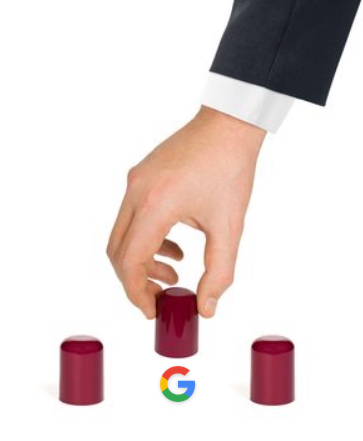
Is Google simply above the law?

Google Shell GameIncreasingly, in the United States, the answer to that question seems to be yes.  As Exhibit A, I offer this latest anecdote from Ellen Seidler at VoxIndie, who describes the experience of one indie film distributor who found an entire film uploaded to YouTube by some smug little snot with the handle Free Movies. The film distributor had used its ContentID account to “block uploads of certain lengths in its territories,” writes Seidler, but Free Movies decided that the distribtutor doesn’t have the right the block the film in any context whatsoever.  Seidler describes the situation as follows:

S/he [Free Movies] stated the reason as being:  Approval from copyright Holder is not required.  It is fair use under copyright Law. The user also added a note: ‘I don’t need to explain.’

Despite all the testimony at last week’s roundtable about fair use–and how copyright holders seek out [sic] to punish those who claim it using malicious takedowns–it’s worth pointing out, yet again, that for every legit “fair use” claim, there are also false, and rather malicious, abuses of that defense.  It’s a fact conveniently overlooked by the anti-copyright apologists.”

YouTube restored access to the entire film (which would never ever be a fair use!), the distributor’s claim was then reinstated, and Seidler rightly points out that if Free Movies files a counter notice, that’s the end of it.  These indie filmmakers don’t have the resources to files suit in federal court, so Free Movies and YouTube can not only get away with the infringement, they can even monetize it together—earning revenue from the labor of other people.  Because freedom.

But if Google is going to support—and even encourage—this kind of behavior on its platforms, and if Congress isn’t going to fix the law to give rights holders a fighting chance, then let’s at least be honest about what this mess really is.  Google should simply instruct its users to file responses and counter notices invoking the words hocus-pocus or swordfish or expelliarmus, and then these infringing files can remain on YouTube. Because fuck you.

Why bother even bringing up a complex legal doctrine like fair use? Clearly, Google’s intent is to ensure that users like Free Movies remain wholly illiterate about the principle; and the independent creators can’t afford to go to court anyway.  I’ve argued in the past that fair use is not just an incantation that makes infringement claims go away, but maybe I’m wrong.  Because Google is apparently above the law. So, if that’s the new reality, lets be honest about it and not add insult to ignorance by pretending a legal principle is even being applied in such a case.

As Exhibit B, Conor Risch, writing for Photo District News, describes Google as “too big to sue,” even for a relatively large rights holder like Getty Images.  Ever since Google changed its Image Search format, Getty—the largest stock-photo library representing thousands of photographers around the world—has seen dramatic loss of traffic to its own pages.  Traffic that Google has effectively hijacked.

Prior to the 2013 change, Google Image Search results produced thumbnails of most photos, and when a user clicked on an individual image, he was directed the to the web page hosting that image.  But never content simply to “organize the world’s information,” Google likes to own the world’s attention in order to drive ad revenue and mine data.  So, in 2013, they changed Image Search to provide larger, high-quality images that do not link directly to the owner’s web pages. Instead added a “Go To Web Page” button, and this additional step combined with posting  high-quality images has resulted in a sharp decline in traffic to Getty’s site.

As has recently been reported, Getty is pursuing Google in the EU, where the search giant faces an ongoing and wide-ranging anti-trust investigation.  Getty views Google’s Image Search practices as implicating both copyright and anti-trust law, but even though both companies are based in the US, Getty’s avenues for relief domestically are presently very narrow.  After extensive investigation into the practices of the search giant, the US Federal Trade Commission voted unanimously in 2012 not to pursue Google.  This is in dramatic contrast to the European Commission, which may be about to impose a record-breaking fine on Google for “anti-competitive search practices,” reports Andrew Orlowski for The Register. With regard to bringing a copyright infringement claim against Google, Getty’s General Counsel Yoko Miyashita states, the search giant would simply “wipe us out from a cash perspective” by dragging out the case for years.

Where the copyright and anti-trust issues converge is when the company that is too big to sue is also the company that is too big to ignore. As Miyashita explains in the Risch article, “Are there copyright issues? Yes. But the problem is not just copyright. It’s their market dominance and their position in search where they can circumvent any of the copyright protections that legislatures or courts may provide.”

By way of example, Miyashita cites legislation passed in Germany and Spain that was designed to protect news publishers in those countries by requiring compensation for Google’s use of news snippets. Google’s response?  De-indexing those publications from its search engine—a practice that Google’s own spokespeople and attorneys will typically claim “chills free speech” whenever a plaintiff seeks an injunction to de-index links or sites that are clearly infringing intellectual property or violating privacy.  The same company that will insist that access to the web is a universal and inviolable civil right will gladly remove entities from its near-monopoly search engine when it has a buisness interest in doing so.

Technically, even under the DMCA as it is written, the above-mentioned FreeMovies is supposed to lose his/her YouTube account as a repeat infringer.  But no.  Such a remedy is labeled as “censorship” by Google and its Kool-Aid drinking buddies at EFF, et al. But it’s okay to remove news organizations from search when it serves Google’s bottom line.  Again, if this is how things are, if Google is simply above the law, then let’s abandon the nuanced language of law altogether.  Let’s just say it’s Google’s internet and they can do whatever the hell they want with it.

It’s called being creative. On memes and copyright.

I feel a little bit bad picking on Washington Post tech writer Caitlin Dewey as much as I have already, but it’s probably not as much as I would if I read her column with any purposeful frequency.  Unfortunately, given the subjects I write about, people like to send me links to her articles. And I read them. And then the voices in my head start yelling because she’s said something deeply ill-considered in a high-profile newspaper. And then typing happens …

So, one of Dewey’s recent observations concerns the possible extinction of “our favorite memes” from the Internet thanks to copyright enforcement by owners of the rights to the underlying images on which said memes may be based.  Specifically, she cites what is supposedly an Internet legend known as Socially Awkward Penguin, which originated on 4chan (snort-laugh).  The meme features a copyrighted image of a waddling penguin, originally captured by veteran photographer George Mobley, which has been remixed and repurposed to produce various funny (or not) aphorisms on the theme of awkwardness.

Now, I certainly won’t disagree with Dewey that the meme is a perfectly valid form of expression, though how much cultural importance we can ascribe to the medium, I suppose, depends very much on each meme and the context in which it is used.  For instance, I think I’m all set with the constant repurposing of that screen-grab of Gene Wilder flashing his Willy Wonka smirk as the predicate to every sardonic comment anyone cares to convey on any number of issues. And that gets to the real point about any expression, which makes use of existing material:  it doesn’t necessarily need to. And, guess what happens if, say, a meme maker respects the rights of the owner of the original work?  He or she communicates the same idea in some other way.  It’s called being creative.

Anyone who creates stuff will tell you that being forced to work around an obstacle — like not boosting someone else’s work — almost always produces something better than what was first imagined because the new work becomes a legitimately new expression. And this is likely to be just as true with a meme as with any other medium.  I’ve written about this theme before and have also cited a relatively recent work of scholarship called Working Around Copyright by Joseph P. Fishman at Harvard Law School.

The assumption made by those who’ve grown up with what they think is a new idea called “remix culture” is that creativity depends on unlimited use of existing works. But if SAP (Socially Awkward Penguin) was destined to become part of the digital-age vernacular, then there’s no reason to assume that this form of shared expression would have been diminished if the originator of the meme had taken inspiration from Mobley’s image rather than taken the image itself. Hence, the assertion that copyrights “stifle creativity” is an oxymoronic claim because the author who derives, works around, and creates anew will always be more creative than the author who copies and pastes.

Now, the legal story Dewey cites in order to justify the misleading headline saying that our favorite memes are being killed by copyright involves Getty Images, which manages the rights for Mobley’s original penguin photo.  Dewey writes, “In the past year, the company’s licensing agency, Getty Images, has ‘pursued and settled’ multiple infringement cases involving Socially Awkward Penguin, it confirmed to The Post. All of those actions were carried out in secret, with blogs and other posters agreeing to non-disclosure.”

We’ll get to the “secret” part in a moment, but suffice to say, one of these sites, German-based getDigital agreed to take down posted SAP memes from its blog and pay a back-dated license fee, but they refused to remain silent on the matter. Instead, getDigital published a blog post about its settlement with Getty, and this post is apparently the foundation of Dewey’s article.  From the big picture, we are meant to conclude that 1) Getty is randomly cherry-picking little sites who can’t defend themselves, which is meant to seem silly given the ubiquity of SAP on the web; and 2) that there is something truly sinister in that condition of silence regarding the settlement.  But as is so often the case when it comes to the Internet and copyright, commentary like this is predicated both on a misunderstanding of the law as well as an implied wishful thinking that it should work differently from the way that it does.  In addition to providing shoddy reporting on the actual issue, this also does a disservice to any site owner or blogger as to what they should and should not be posting.

So, to try to clear up the first part of the confusion in this story, most of us encounter memes on social media sites like Facebook. If we like them, we share them, they go viral, and it’s all a bit of harmless fun.  The reason Facebook is not liable for any infringement in these cases is that the site is protected by safe harbor provisions in the DMCA. These provisions — although they are often applied in a manner in which they were never intended — presently shield a site like Facebook because all or most of the content is uploaded by the users.  But these safe harbors do not apply to a publisher of content on his/her/its own site.  So, if the New York Times, which has editorial control over the content on its pages, publishes a Reuters photo without proper licensing, the NYT is liable for direct infringement of that photo.  Hence, this same rule applies to any site on which the owner controls the content, which would include the blog of getDigital, or even this blog because it is not a platform for UGC (User Generated Content). So, a rights holder like Getty will only go after sites on which the owner controls the content, and a lot of the big publishers know better than to infringe.

Moreover, people need to understand — and Dewey makes this mistake in her article — that money has nothing to do with it!  As mentioned in this post about a friend who found herself in some trouble with a photographer, it doesn’t matter if the use of a work is in any way related to commerce or revenue for the site owner that uses the work.  While commerce may indeed influence the remedies sought by a claimant, money has no bearing whatsoever on whether or not a work has been infringed.  This  is one of the most common misconceptions out there, and it has only been exacerbated by the apparent “freeness” of the Web.  I say apparent because none of this Web stuff is free; it’s just that most people don’t pay attention to the nature of the trade that is happening (but that’s another subject).

As for the settlements between Getty and any site owners, I recognize that secret is a truly dirty word in this age when people have convinced themselves that the Internet provides transparency, but non-disclosure is a pretty mundane, standard practice when settling civil cases of this nature.  The plaintiff agrees not to sue — that’s what a settlement is — but it is in the plaintiff’s interests not to publicly reveal the terms of the settlement for any number of reasons, namely that its right to negotiate with a future defendant not be affected by the terms of prior settlements. With an entity like Getty and a case involving visual media, it’s not exactly like settling with a medical device company that demands silence about some negligence causing physical harm.  That’s nasty stuff.  But this is not that kind of “secret.” It’s just basic practice in many areas of civil litigation; and if you were a plaintiff, you’d probably want the same conditions.

I know there is a lot of noise about rewriting copyright law in the age of the Internet, but it is patently absurd to expect — and self-defeating to hope — that such revision would result in such a shapeless body of law as to condone the free-for-all we perceive the Internet to be and perhaps even think should persist.  But neither the interests of commerce nor those of creative expression are particularly well served by this agenda; and perhaps tech pundits who presume to comment on copyright issues should first get their facts straight before once again claiming that some favored form of expression is being “killed” by this body of law. The meme, for better or worse, can continue to amuse, inform, annoy, or even misinform for years to come, and it can coexist with copyright even without revision. And we’ll all be just fine.  It’s called being creative.

On a side note, Getty does make many of its images freely available to embed as shown above for publishers like bloggers.  What do you think, “Sound of Music Penguin?”