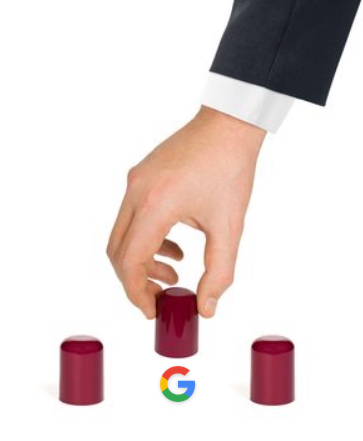
Is Google simply above the law?

Google Shell GameIncreasingly, in the United States, the answer to that question seems to be yes.  As Exhibit A, I offer this latest anecdote from Ellen Seidler at VoxIndie, who describes the experience of one indie film distributor who found an entire film uploaded to YouTube by some smug little snot with the handle Free Movies. The film distributor had used its ContentID account to “block uploads of certain lengths in its territories,” writes Seidler, but Free Movies decided that the distribtutor doesn’t have the right the block the film in any context whatsoever.  Seidler describes the situation as follows:

S/he [Free Movies] stated the reason as being:  Approval from copyright Holder is not required.  It is fair use under copyright Law. The user also added a note: ‘I don’t need to explain.’

Despite all the testimony at last week’s roundtable about fair use–and how copyright holders seek out [sic] to punish those who claim it using malicious takedowns–it’s worth pointing out, yet again, that for every legit “fair use” claim, there are also false, and rather malicious, abuses of that defense.  It’s a fact conveniently overlooked by the anti-copyright apologists.”

YouTube restored access to the entire film (which would never ever be a fair use!), the distributor’s claim was then reinstated, and Seidler rightly points out that if Free Movies files a counter notice, that’s the end of it.  These indie filmmakers don’t have the resources to files suit in federal court, so Free Movies and YouTube can not only get away with the infringement, they can even monetize it together—earning revenue from the labor of other people.  Because freedom.

But if Google is going to support—and even encourage—this kind of behavior on its platforms, and if Congress isn’t going to fix the law to give rights holders a fighting chance, then let’s at least be honest about what this mess really is.  Google should simply instruct its users to file responses and counter notices invoking the words hocus-pocus or swordfish or expelliarmus, and then these infringing files can remain on YouTube. Because fuck you.

Why bother even bringing up a complex legal doctrine like fair use? Clearly, Google’s intent is to ensure that users like Free Movies remain wholly illiterate about the principle; and the independent creators can’t afford to go to court anyway.  I’ve argued in the past that fair use is not just an incantation that makes infringement claims go away, but maybe I’m wrong.  Because Google is apparently above the law. So, if that’s the new reality, lets be honest about it and not add insult to ignorance by pretending a legal principle is even being applied in such a case.

As Exhibit B, Conor Risch, writing for Photo District News, describes Google as “too big to sue,” even for a relatively large rights holder like Getty Images.  Ever since Google changed its Image Search format, Getty—the largest stock-photo library representing thousands of photographers around the world—has seen dramatic loss of traffic to its own pages.  Traffic that Google has effectively hijacked.

Prior to the 2013 change, Google Image Search results produced thumbnails of most photos, and when a user clicked on an individual image, he was directed the to the web page hosting that image.  But never content simply to “organize the world’s information,” Google likes to own the world’s attention in order to drive ad revenue and mine data.  So, in 2013, they changed Image Search to provide larger, high-quality images that do not link directly to the owner’s web pages. Instead added a “Go To Web Page” button, and this additional step combined with posting  high-quality images has resulted in a sharp decline in traffic to Getty’s site.

As has recently been reported, Getty is pursuing Google in the EU, where the search giant faces an ongoing and wide-ranging anti-trust investigation.  Getty views Google’s Image Search practices as implicating both copyright and anti-trust law, but even though both companies are based in the US, Getty’s avenues for relief domestically are presently very narrow.  After extensive investigation into the practices of the search giant, the US Federal Trade Commission voted unanimously in 2012 not to pursue Google.  This is in dramatic contrast to the European Commission, which may be about to impose a record-breaking fine on Google for “anti-competitive search practices,” reports Andrew Orlowski for The Register. With regard to bringing a copyright infringement claim against Google, Getty’s General Counsel Yoko Miyashita states, the search giant would simply “wipe us out from a cash perspective” by dragging out the case for years.

Where the copyright and anti-trust issues converge is when the company that is too big to sue is also the company that is too big to ignore. As Miyashita explains in the Risch article, “Are there copyright issues? Yes. But the problem is not just copyright. It’s their market dominance and their position in search where they can circumvent any of the copyright protections that legislatures or courts may provide.”

By way of example, Miyashita cites legislation passed in Germany and Spain that was designed to protect news publishers in those countries by requiring compensation for Google’s use of news snippets. Google’s response?  De-indexing those publications from its search engine—a practice that Google’s own spokespeople and attorneys will typically claim “chills free speech” whenever a plaintiff seeks an injunction to de-index links or sites that are clearly infringing intellectual property or violating privacy.  The same company that will insist that access to the web is a universal and inviolable civil right will gladly remove entities from its near-monopoly search engine when it has a buisness interest in doing so.

Technically, even under the DMCA as it is written, the above-mentioned FreeMovies is supposed to lose his/her YouTube account as a repeat infringer.  But no.  Such a remedy is labeled as “censorship” by Google and its Kool-Aid drinking buddies at EFF, et al. But it’s okay to remove news organizations from search when it serves Google’s bottom line.  Again, if this is how things are, if Google is simply above the law, then let’s abandon the nuanced language of law altogether.  Let’s just say it’s Google’s internet and they can do whatever the hell they want with it.

Stay Down Provision Will Not “Entrench” YouTube Dominance

This is an argument that’s been around for quite a while.  I first stumbled upon it in 2013, found it again in the recently published report by Berkeley and Columbia researchers, and I understand it came up again in round-table discussions held last week at the 9th Circuit Court of Appeals regarding Section 512 of the DMCA.  The premise is this:  that if rights holders demand a takedown provision, and this in turn requires technological measures to achieve, then such measures will entrench the dominant market positions of sites like YouTube because only giant companies will be able to afford to deploy these technologies.  It sounds like a reasonable concern as long as we ignore the realities of the networked economy.

YT GorillaYouTube’s dominance is created by market forces and the general tendency of a networked economy to foster monopolies.  As discussed several times on this blog, and in numerous articles from multiple other sources, it’s a natural function of the digital market to shrink competition in certain lines of business.  Once a platform acheives critical mass and offers a service like social video, there is not only no particular need for consumers to seek a competitior, there are clear disadvanages to choosing a competitor.  For instance, one can host video on a service like Vimeo, which offers many great features, but if one needs to drive traffic and improve SEO, there really is no substitute for YouTube, especially because of the way in which the platform is intertwined with Google’s dominant position in global search.

These are market factors that have no direct relationship with provisions like YouTube’s Content ID or other copyright compliance (or lack thereof) policies and technical measures.  If anything, it is astonishing that self-proclaimed public advocates can pretend to be criticizing YouTube in this regard when it is that company’s bad-faith application of DMCA in the first place which enabled it to gain the monopoly position it now enjoys. YouTube brazenly acquired its marketshare with an infringe-now/sort-it-out-later strategy; and now its representatives, in the guise of defending competition, have the nerve to suggest that technical measures to achieve stay down will only “entrench” this ill-gotten dominance. So, if we’re going to debate any technical measures that may be required for a YouTube-size OSP to fulfill a stay down provision, that discussion should only proceed based on an honest appraisal as to why certain OSPs are already monopolistic and may remain so regardless of any new requirements to protect rights holders.

Additionally—and I’ve raised this issue before—we saw in BMG v COX that new technical measures are not the only approach to acheiving better compliance with the intent of DMCA safe harbor provisions.  As the law stands today, in order to maintain the safe harbor shield, an OSP must meet certain condions, and among these is the maintenance of a policy whereby a repeat infringer will ultimately lose his or her account with the OSP.  But ever since passage of the DMCA, OSPs, bloggers, pundits, and organizations like the EFF have been playing a semantic shell game with rhetoric like What is a repeat infringer? And while it is true that the DMCA does not specify the exact terms of a repeat infringer policy, the details revealed in BMG v COX demonstrate just how absurdly “good faith” can be abused by a service provider.

As described in a previous post, COX’s “repeat infringer” policy was what we might call Fourteen Strikes and You Get a Very Stern Warning.  As a result of this clearly insufficient policy, the judge in the case rather sternly rejected COX’s initial safe harbor defense and allowed the trial to proceed, in which BMG ultimately prevailed.  The reason I bring up COX is that the failure of DMCA to protect rights holders in this instance does not implicate new technical measures at all. Instead, COX suggests that the language of the law is too broad and can, therefore, be willfully misinterpreted by an OSP as to undermine the intent of DMCA.  BMG had to go to court to demonstrate that COX was not anywhere close to meeting its obligations to provisions that were meant to be a compromise measure designed to avoid litigation in the first place.  COX itself does not concern a stay down provision for an individual file, but the repeat-infringer issue, it seems, may be viewed as a parallel subject for proposed statutory revision.

And so the circumstance we have now—especially the story that leaks out into the public dialogue—is a double-lie.  Part one is that new technological measures are the only way to mitigate repeat infringement of individual files or by individual users; and part two is that these technical measures can only “entrench” monopoly OSPs despite all evidence that these monopolies may persist due to market forces.  As policy-makers consider revision of Section 512, I believe it is worth noting the fundamental dishonesty of these arguments and to ask why, after so many years, they remain lead talking points of the internet industry.

Fight for the Future Naive About King “Dream” Speech

FFTF Dream Screen Shot

I have a dream that one day my children will be judged not by the content of their character, but by the content they can steal.  

So, my friend David Lowery, on his blog The Trichordist, has been taking the organization Fight for the Future to task lately, and he most recently caught the organization in a lie related to DMCA  takedown and their defiant upload of Martin Luther King’s “I Have a Dream” speech to YouTube. Back in 2013, to celebrate the  first anniversary of the defeat of SOPA, FFTF posted the “Dream” speech to YouTube in direct violation of the King estate’s copyright in the work; and the group told people to share the clip in what they called a “small act of civil disobedience.”  Small indeed. It’s bad enough to conflate the whinging, privileged, and corporate-backed “fight” against SOPA with the deadly labors of Dr. King, but there’s something even more insidiously galling about this whole MLK/copyright conflict that Fight for the Future and their ilk really don’t understand.  And maybe it’s because they grew up in a world of sound bites.

Since roughly five minutes after the Constitution was ratified, this country has been trying to live up to its own ideals, and getting there—and we’re not there—has taken decades and cost many brave people their lives.  In that speech on the steps of the Lincoln Memorial, King is demanding that America be true to its principles when he invokes the Declaration’s all men are created equal.  Those words are Jefferson’s preface to citing the natural rights of Man, which Jefferson cribbed from John Locke, whence comes the idea that the fruits of one’s labor are a civil right.  King’s enormous contribution is a part of that continuum—a history of struggle for the value of the individual voice to vote to speak to protest and to enjoy the fruits of his or her labor on equal footing with all other citizens.  And that last principle is why the intellectual property clause exists in the Constitution in the first place.

Yes, Dr. King is a big part of America’s struggle toward its best intentions, but it isn’t just a story about prejudice against race or sex or identity; it’s a story about the value of the individual and his or her right to pursue happiness.  Hence labor rights are invariably a central component of every civil rights battle ever fought—from literal slavery to the workers’ rights of the early 20th century to ongoing demands for equal work opportunities for women.  When Martin Luther King was murdered in Memphis on April 4, 1968, he was there to protest the exploitation of city garbage workers.  Even the “Dream” speech itself was part of a march called “The March on Washington for Jobs and Freedom.”  The value of the individual’s labor is a cornerstone of civil rights; and what these featherweight activists at Fight for the Future completely fail to realize is that intellectual property rights are a significant expression—in fact the first legal expression in this country—of that fundamental principle.

Meanwhile, the free speech we enjoy—the free speech groups like FFTF believe is threatened by the King family’s copyrights—owes a great deal to the courage of King and his followers.  In the 1964 case of New York Times Co. v Sullivan, Alabama courts upheld a libel claim against the Times for publishing an ad called Heed Their Rising Voices in support of the King-led marches in the South.  The city commissioner of Montogomery L.B. Sullivan sued over the negative portrayal of his police department, and had the US Supreme Court not overturned key precedents in the lower court rulings, then the power of newspapers and public advocates to criticize elected officials and government agencies would likely have been diluted for many years to follow.  So, even with regard to free speech itself, all this digital-age dithering over a work that is widely and affordably available is a little pathetic in context to the history in which these people are dabbling.  (Coincidentally, I watched the “I Have a Dream Speech” last night, for the zillionth time in my life, as part of Episode 5 of the CNN-produced series The Sixties, now streaming on Netflix).

So, yeah, we can debate the practical application of copyright, discuss whether or not a particular work should remain protected and for how long.  But when a bunch of privileged, 21st-century kids (backed by very wealthy corporations, I might add) declare, from the comfort of their keyboards, that the emancipation of Dr. King’s speech from the “chains of copyright” is somehow a fight for civil rights, I propse that FFTF should change its acronym to STFU.  This is especially true when their idea of a “moral responsibility to disobey unjust laws” means in this case to serve King up to corporate masters so his legacy can rightly become their property to monetize rather than his family’s.

My generation grew up with Dr. King’s words as part of our consciousness, miraculously without the aid of YouTube or the internet.  In fact, it’s noteworthy that the limited scope of access in the 1960s probably played a significant role in accelerating the progress of particularly the Voting Rights Act.  Because the first wave of Selma marchers had the unbelievable guts to walk unarmed into a mob of cops and goons brandishing knightsticks, pipes, and barbed-wire-wrapped clubs, and because the enitre nation was limited to just a few TV networks, it meant that tens of millions of citizens simultaneously watched—in a sense were forced to watch—the sight of innocent people being mauled. So, our new world of abundance isn’t always the potent, connective tissue we think it is.

Probably the most telling irony in this story is that by spending so much energy and corporate money fussing about the copyright on Dr. King’s “I Have a Dream” speech, the folks at Fight for the Future demonstrate that they don’t really seem to understand the speech at all.  They demand access on principle but learn nothing about the work itself.  And if that isn’t the lie of the digital utopia writ large, I don’t know what is.