In praise of Elizabeth Wurtzel and “Creatocracy”

“What would the world be without America? It would be a dull and dinky planet indeed.”
– Elizabeth Wurtzel –

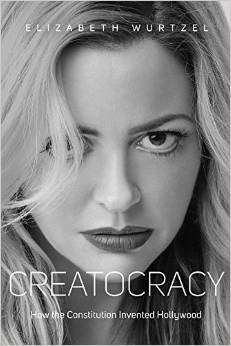
In honor of the 225th Anniversary of the first copyright act of the United States (May 31, 1790), I’d like to recommend a little book that neatly offers both a primer and a rationale for intellectual property in the United States. Creatocracy:  How the Constitution Invented Hollywood, by author and attorney Elizabeth Wurtzel is an unabashed, patriotic affirmation of the Progress Clause, reminding us that its inclusion in our Constitution can be explained by the same reason we have the United States at all:  because it seemed like a good idea at the time.
Unknown
Photo by Jason Myers

“There’s no particular reason that the Constitution, which otherwise contains few frills, should bother to make mention of something as luxurious to a nascent nation as intellectual property,” writes Wurtzel.  “And yet, there it is. As such it made America. Because of intellectual property, we live in a democracy of ideas and not a plutocracy of provenance.”

In just about ten thousand or so words, Wurzel flaunts American exceptionalism in both creative and practical inventions with the kind of energy in her writing that Kerouac gave to his love of jazz.   She gets in your face and tells you unequivocally that America is the coolest country in the world and that it has the almost incidental establishment of intellectual property law to thank for that coolness.  She reminds us that implicit in the Progress Clause is the same contagious, unwarranted optimism that created America in the first place. Drawing upon the fact that the nation itself is an improbable, even preposterous, invention, she cites the historical irony that no revolution of such magnitude had ever been fought, let alone won, by a people who had it so good. So, of course that same restlessness would eventually land men on the moon (and bring a car!), invent Rock-n-Roll and the Internet, build the largest military force in the world, and make a motion picture that cost a gazillion dollars just to produce a mediocre melodrama tacked onto an epic recreation of the epic sinking of the Titanic.

In fact, Wurtzel’s example of extolling the scope and audacity of James Cameron’s blockbuster is a pretty good metaphor for why I choose to defend copyright.  Sure, I criticized that film for all the subtle moments of pathos the script forgoes in favor of dime-novel sentimentality. And I have certainly never been a teenage girl who would return to the theater a dozen times to watch Leo sink into the Atlantic. But I agree with Wurtzel that we have reason to celebrate the gall that made that over-hyped, over-budgeted movie because it could have been a disaster, but it worked. And for better or worse, that has been the American story over and over again.

Likewise, it really is kinda cool that the Framers almost haphazardly established the basis for intellectual property while cobbling together a new nation populated by semi-literate and generally unwashed farmers. “… it was a supreme leap of of faith to believe that there would ever be culture in this country …,” writes Wurtzel. And although it is necessary and relevant that we critique law as we might critique Titanic, when that criticism lapses into futile cynicism, we do often forget to have fun. Wurtzel’s enthusiastic little book reminds me that every time I hear or read some high-level, academic, legal theory banging on about natural laws and government-granted monopolies and maximalism and so on, I often want to say, “Dude, whatever. It worked. We totally got Elvis and Ray Charles and Star Wars and the Corvette and, yes, even Google. So, quit being a stick in the mud, and go fix something that isn’t working!”

I often worry that the America envisioned by some of the more extreme intellectual property rights reformers would look more like China, which we might describe as the Elvis impersonator version of a culturally diverse society.  Whether it’s software or handbags or CDs, there’s something fundamentally depressing about a nation filled with so many knockoffs, lacking a system for creating a more diverse bounty of their own cultural works and inventions or even a system for acquiring our works in fair trade. It’s what a market looks like where there are limited moral boundaries like intellectual property or human rights that are tethered to the foundations of free enterprise.  In Creatocracy, Wurtzel celebrates the fact that copyrights and patents make commerce out of intellectual and creative endeavor because commerce is the ultimate democracy.  Yeah, money makes people do bad things sometimes (or more often just lame things), but that’s exactly why our system based on IP is brilliant — because it does the best job of removing both government and aristocracy from the creative process and gives the power to the people. “Here the idea was everyone would buy a ticket or purchase a copy, and voila — fun!  Everyone pays a little and gets back a lot. Culture is as democratic as government. When it comes to taste, the people rule,” she writes.

But I have seen folks suggest on this blog and elsewhere that perhaps patronage or publicly-funded works would be preferable to the intellectual property system we’ve had so far. This view is not only cynical (and really boring), it’s contradictory.  These folks argue that, on the grounds that copyrights are “government-granted monopolies that keep creative works from the people” (which makes no sense on the face of it), they would sooner see a system in which only large corporations, wealthy individuals, or members of Congress sponsor creative taste and/or R&D in this country.  How is that in any way an antidote to the consolidation culture these same critics (and I for that matter) view as socially regressive? These same people have yet to recognize that their anti-copyright, populist, free-for-all has so far made creative works more corporatized and driven popular creators toward patronage-like models to survive.

The Silicon Valley tycoons and their vast PR network love to talk about “permissionless innovation” as though intellectual property were the barrier preventing that innovation.  But their blindness in this regard is why, for all their new-money insouciance, they’re really a bunch of fuddy-duddy corporate wonks. They miss the point that the individual rights granted to inventors and creators is the legal embodiment of permissionless innovation. It is constitutionally guaranteed permission to not ask permission of anyone other than an audience or a customer. It’s why the Dead Kennedy’s got away with saying “Fuck The Man.”  Because The Man, no matter how rich or powerful he may be, can still only buy one ticket relative to an audience of millions of screaming, head-banging fans.

As Wurtzel points out, while American fine arts are something of a carry-over from our cousins across the pond, the breadth and depth of expressions written onto “celluloid and vinyl and acetate” are distinctly American.  And despite the inexorable, so-called progress of these tactile media into drab, invisible ones and zeroes, we should not let that be the reason to starve genius or stifle the quixotic madness that may produce big, daring works just because we can. There’s plenty that American exceptionalism does not get right. We believe our own press and too often confuse our mythology with history. We can’t always tell the difference between reality and a movie, but whether we do the most audaciously noble or the most audaciously terrible thing in reality, it’s worth noting that we always relive, re-contextualize, and reexamine those truths through our movies. “Our movies are America,” writes Wurtzel. And I think she has a point.


Elizabeth Wurtzel is also the author of Prozac Nation and Bitch: In Praise of Difficult Women.

DCA Releases New Report on Ad-Supported Piracy

The Digital Citizens Alliance, has released its second annual report on the for-profit, ad-supported media piracy trade.  In collaboration with MediaLink, the report titled Good Money Still Going Bad studied 2014 data to reevaluate the central questions posed in the research done with 2013.  How profitable are these pirate sites, and where does the money come from? The macro view is much the same as the prior year.  Piracy is still big business, and brand advertising represents the lion’s share of the revenue.  Several sites that were operating in 2013 were gone, while new sites came online.

Overall, revenue ($209 million) for the sites studied appears to be relatively flat, but there are some new trends apparent in the 2014 data, notably a shift among users from illegal download portals to illegal streaming portals.  This is significant because video ads are more valuable than banner ads and can be embedded into streams so that viewers are forced to see them.  But let’s take a step back for a moment and understand what reports like this one from DCA and MediaLink tell us about the revenue streams for pirate sites, regardless of scale of the enterprise or delivery platform.  Because for all the ersatz intellectuals who tread the boards on TEDx to talk about “sharing” and piracy as some sort of socially or ideologically progressive revolution, it’s important to remember that this black market simply would not exist without the money that is available exclusively in a bottom-feeder’s strata of trade. Revenues for these sites are generated by essentially three drivers, in the following ascending order:  malware, affiliate marketing, and advertising.

Malware

Of the 589 sites studied for this report, at least one-third contain bogus links that offer to “update players” and other options designed to fool users simply into thinking they need to go through such steps in order to watch a program they’ve selected. The site owners are paid for every click, and the bogus players and plug-ins users think they’re downloading install malware that is typically used to facilitate identity theft and other data abuses tied to profitable criminal activity.  I discuss this in more detail in this post regarding another report released by DCA in collaboration with NetNames.

Affiliate Marketing

The estimated total revenue earned by the sites studied is $209 million.  Of that total, I am told by Mark Berns of MediaLink that roughly $60 million is generated via links to affiliate marketing. Affiliate Marketing is a generic term for advertising that links directly to services and products in which an actual transaction takes place between consumer and some third party with something to sell. Not everything sold via affiliate marketing is a scam, but it is a great platform for all manner of scams, from get-rich-quick promises to bogus “dating” services to nine zillion secrets to six-pack abs.  So, if a user ends up buying Guru Gus’s Great Guide to Getting Gorgeous Girls, Gus is happy to pay the pirate site owner who attracts that sucker with ads that provide click-through to his e-commerce site.  And of course on many pirate sites, some of the ads are even more unsavory with possible ties to sex tourism that may be directly linked to human trafficking.

Brand Advertising

Such unappealing associations, along with the exploitative nature of piracy itself, have led the major advertising community to begin looking for ways to extricate their brands from  the piracy business.  The $149 million in advertising revenue indicated by the report represents media budget dollars that we might say fall through the cracks of the online media buying system. As explained in other posts, the major brand advertisers do not intentionally seek to place their ads on these sites; the ads wind up there as remnants via secondary or tertiary media placement companies. And while no advertiser likes waste, the truth is that $149 million spread across the media budgets of even just a few hundred major brands does not represent massive waste in hard dollars relative to other forms of waste in traditional advertising.   But, as the report points out, “Legitimate brands take a double hit when their ads appear on content theft sites. Their reputations suffer by association with content theft itself and with the illicit services whose ads also appear on the sites. In addition, they are being defrauded. The money they spent to advertise on legitimate sites is instead fueling content theft, and the impression counts are being boosted by bots and other fraudulent means.”

GoodMoney_Infographic3a

Regardless of any attempt to measure exactly how many dollars are wasted, what both advertisers and advertising professionals have begun to take most seriously, is the damage done to brand value (which represents billions in investment) when their brands are associated with sites that are both criminal in function and sleazy in nature.  Tiffany doesn’t want to be associated with Guru Gus’s Guide just like Bank of America clearly doesn’t want to be associated with a site that feeds people malware that can result in identity theft.  And in an effort announced this past February, major advertising organizations launched a new program designed to create a kind of Good Housekeeping Seal of Approval (in this case Digital Advertising Assurance Providers or DAAPs) to give advertisers insight they can use to protect the integrity of their brands.

The 2014 data in this report reveals a slight drop ($18 million) in total revenue overall since the study of 2013 data, but that is not an indication that the profitability of piracy is trending downward. For one thing, the dynamic ecosystem in which sites continuously disappear and reappear means that the revenues will vary depending on when the data are collected. Moreover, the aforementioned rise in illegal streaming is the one category that appears to be growing. As stated in the report:  “Video Streaming Host Sites segment was the only one in which revenue grew from 2013 to 2014, fueled by higher video CPMs and a 40% increase in the number of sites. Average site revenue more than doubled for sites in the segment, and aggregate revenue was up 68.2% to $46.2 million.” Illegal streaming poses a significant threat to both the media producing and the advertising communities, particularly as it offers a much easier user experience than Bit-Torrent or cyberlocker portals. In all likelihood, this report reveals the start of growth in the illegal streaming market rather than a plateau.

Ultimately, reports like this are most meaningful to major advertisers whose coffers very clearly, however unintentionally, provide 75% of the revenue that supports these exploitative sites.  It’s time for that to change.  Having been around advertising people my whole life, I believe the brand managers and ad professionals are predisposed to want to make that change, and I hope good-faith efforts continue in that regard.  And just think, if the advertisers are able to starve content thieves of enough revenue, a really cool byproduct might be that we don’t have to listen to any more idiots on TEDx tell us how piracy is all about freedom.

Coalition Claims to Seek Balanced Copyright

balanced?.001Once again, a confederacy of the usual suspects has regrouped, rebranded, and relaunched a campaign on copyright in the digital age. They call themselves the Re-Create Coalition. David Lowery on the Trichordist referred to them as “getting the band back together,” and it is true that this familiar list of mostly Google-funded organizations (with bizarrely similar logos) has been trying to get its act together, a bit Keystone Cop-like, ever since the defeat of SOPA in an effort to relive that glory day. Once again, they are eager to rally citizens to their point of view on copyright, though that point of view may be hard to discern if you’re looking too carefully for specifics.  Broadly, the coalition says it wants to balance the rights of creators, consumers, and innovators, which happens to be more or less the goal of every copyright professional since James Madison. So, the only thing that matters is what’s behind those pretty words.

Does copyright need changing in the current market?  Sure. Register of Copyrights Maria Pallante was on Capitol Hill this week offering testimony in the final round of hearings on that very subject.  But like any complex system that might demand revision to conform to a new market, it’s reasonable to assume we’re talking about tweaks, not radical overhaul. Or to paraphrase author and attorney Elizabeth Wurtzel, law requires “granularity” to make it work. Because on the whole, copyright is relatively balanced except in the eyes of extremists and really big Internet corporations, who consider the whole legal framework (not to mention legal frameworks in general) a nettlesome barrier to their dreams of world domination.

Funding source alone does not negate the arguments or a point of view of a group or organization.  Nearly all organizations are funded by private industry in one way or another.  But readers should bring at least a dash of salt to the party when the company that’s been described as the most powerful in the world (i.e. Google) walks into the room and says, “We want a level playing field.”  In general, populist words alone don’t mean anything; mission statements are usually boilerplate.  There are plenty of organizations out there that use terms like freedom and fairness and American ingenuity while behaving as the most industry-serving, right-wing, bigoted group of grumpy white men you ever wanted to meet.  So, cutting through the fog a bit, what does the Re-Create Coalition appear to care about?  Based on their stated agenda, they seem to be focused on two things above all:  fair use and safe harbors. So, let’s look at those …

Take the example of my friend Sarah, cited in my last post, who inadvertently committed copyright infringement on the assumption that her use of a photograph as a supplemental asset on her blog was a fair use.  If we were to, say, broaden the application of the principle to include her use in this instance, that would not be balancing copyright so much as it would erase the purpose of having a fair use exception mean anything at all. It would simply be a free-for-all. If, on the other hand, we review statutory caps on awards for damages so that honest mistakes like hers cannot induce undue financial burden, perhaps there is room for some nuanced adjustment to the law. And admittedly, this appears to be one focus of the coalition. But …

Even the matter of statutory limits might be pretty tricky.  Potential damages function as a deterrent to unlicensed use.  Lower those barriers too far, and it’s not just the big corporations who can get away with anything.  Although it’s not a copyright case, the recent story about the couple whose engagement photo was used without permission on the cover of a cheesy, self-published erotica novella makes a pretty good example of what the market might look like without barriers (what Jaron Lanier calls levees) — rampant violation of several forms of IP rights.  Ironically enough, it probably wouldn’t take too many incidents of personal photos being ripped from social media and used in unpalatable ways like this before people started to think twice about sharing photos on social media.  So, IP barriers play a role in what the Re-Create Coalition folks call the “innovation economy,” too.  And ultimately, why should Amazon earn dime one from the sale of this self-published book (or perhaps hundreds just like it) when those sales involve printing and distributing a couple’s photo without their permission and in a way they find degrading?  So, fair use is good; we all like it.  Is it a doctrine in need of “re-balancing?”  Certainly not if all it does is tip the scales in the favor of one industry.

Perhaps more telling is that this old group with the new name sounds rather keen on calcifying safe harbors within the DMCA (Digital Millennium Copyright Act) and the CDA (Communications Decency Act), both authored in a time when the Internet functioned very differently than it does today.  So, when they say they want to balance copyright to protect the rights of creators without standing in the way of innovation and opportunities provided by the digital age, they don’t necessarily mean they want to update statutes that have protected mass infringers in a manner in which the law never intended.  For instance, YouTube has profited from mass infringement thanks to these safe harbors, yet this group’s call for “balance” in this regard is to leave that puppy alone.

Don’t get me wrong, I’ve said in other posts that these safe harbor provisions are important; they’re important to copyright interests as well.  But what’s happened in the case of YouTube is that the application of these provisions provided a free ride to that company, which in turn enabled market dominance it could then leverage to effectively force, for instance, musical artists to accept their lousy Music Key contracts.  The outcome is not only unbalanced, but it’s a worse deal for creators than some of the most underhanded recording contracts ever written. Yet, this progressive-sounding, forward-looking group isn’t talking about updating these 20-year-old components of copyright law.

Are there abusers of copyright?  Absolutely.  And they are as despised by serious copyright defenders as they are by anyone else. Nobody who believes in a set of principles likes to see those principles misapplied.  But abuse is the exception, not the rule; and laws should be written to support the rule.  Speaking of exceptions and rules, here’s a familiar refrain by Executive Director of the R-Street Institute Andrew Moylan, cited on the press release announcing the new coalition:

“The Internet has lowered the barriers for everyone. As technological innovation continues to advance at a rapid pace, copyright law must catch up. Overregulation protects past success at the cost of future opportunities and allows for exploitation of the current system.”

Sounds reasonable, but allow me to translate.  “Copyright terms are too long and only used to protect corporate rights holders (*wink* Disney), and this stands in the way of new creators entering the market.”

But here’s the market reality:  No matter how long or short copyright terms are, devaluation of works due to mass piracy as well as predatory practices by Silicon Valley interests have reduced investment in viable avenues for professional creators.  Thus, while the Internet does “lower barriers” for creators to showcase their works, the companies that dominate digital space have contributed substantially to the reduction of opportunities for those same creators to turn the prospect of discovery into sustainable entrepreneurism.

Meanwhile, to paraphrase Robert Levine, author of Free Ride, “It doesn’t matter if copyright is life plus 50 years or life plus 70 years. Because on the internet, copyright lasts about ten seconds.”    So, balance that, and then maybe we can talk.