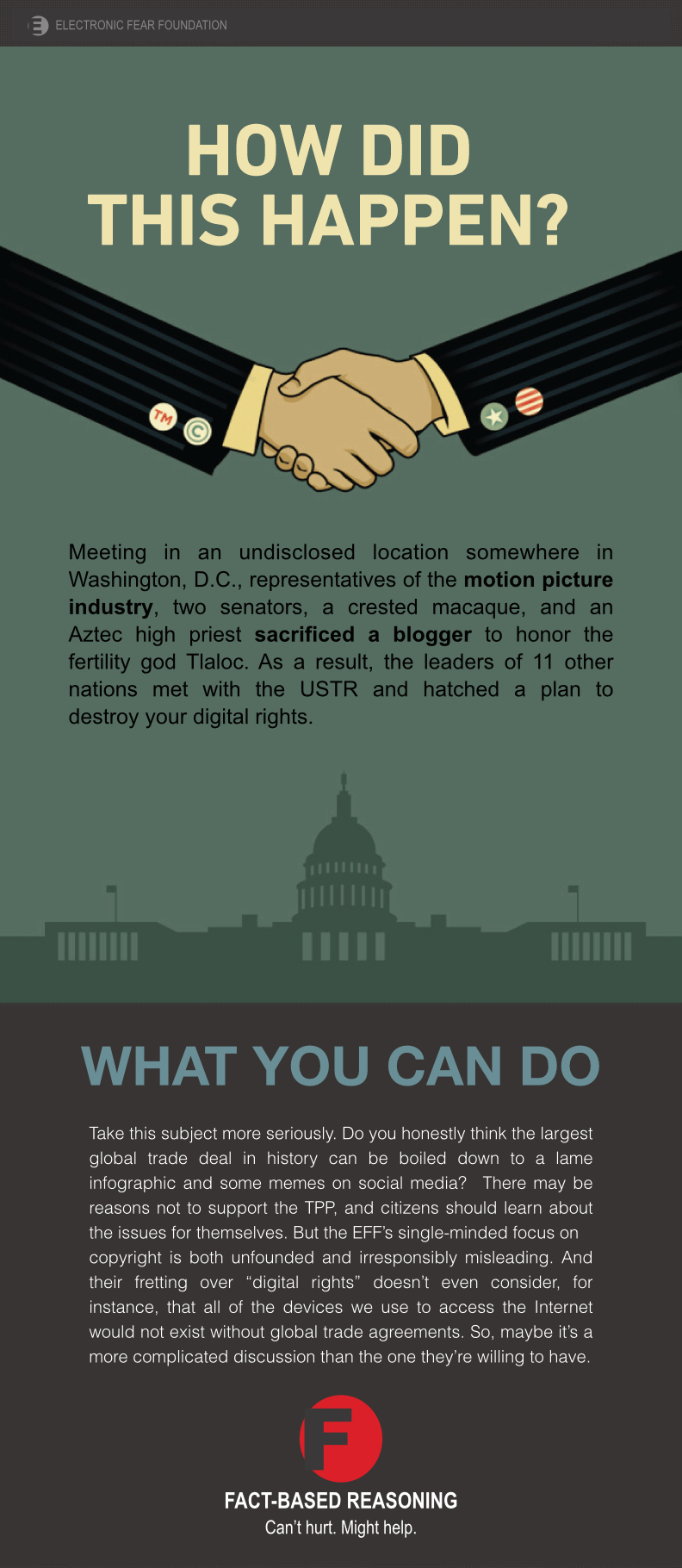
So, this week, the Electronic Frontier Foundation launched its new infographic (stress on graphic) still pitching the idea that it is the IP provisions in the Trans Pacific Partnership agreement that are of the gravest concern. The EFF states on their site that the infographics are covered by a Creative Commons license* and that anyone is free to use or remix the assets with attribution. So, with all due credit to the EFF for the original works, I have taken the liberty of remixing as suggested. And in the spirit of sharing, feel free to use these on social media with or without attribution.
Category: Law & Policy


The Revolution in the Mirror is Closer than it Appears

The father of modern chemistry Antoine-Laurent Lavoisier was beheaded in 1793 in what is now the Place de la Concorde. A victim of France’s post-revolutionary Reign of Terror, he was specifically marked for execution by one vengeful, lesser scientist named Jean-Paul Marat, whose incorrect theory about combustion had been publicly scorned by Lavoisier at the royal academy.
It’s rare when revolutions do not produce new tyrants, and of course the fact that our own war of independence avoided this fate is a legitimate source of national pride for Americans. This doesn’t mean we’ve managed to avoid tyranny altogether, only that our despots tend to be CEOs instead of warlords.
In an article for Evonomics, Lawrence Lessig writes, “ … the biggest danger to free markets comes not so much from antimarket advocates (the Communists and worse!) as from strong and successful market players eager to protect themselves from the next round of strong and successful market players.”
Lessig is of course referring to historical precedent in which “old innovation” employs—or even revises—legal mechanisms as a means of protection against “new innovation”. The familiar narrative is one in which the legacy industry clings to power for as long as it can while new industry inexorably builds the market of tomorrow. Referring to the protectionists as capitalism’s biggest enemies, Lessig sets the stage as follows:
“…there are only two things we can be certain of when talking of free markets: first that new innovation will change old; and second that old innovation will try to protect itself against the new.”
In the article, he identifies this protectionism as the kind of crony capitalism in Washington that ought to make allies of “progressives on the Left and free-market advocates on the Right”. And indeed, this type of alliance did manifest in 2012 with the shouting down of the SOPA and PIPA bills, when we saw paradoxical solidarity among members as divergent as the ultra-conservative Heritage Foundation and the anarchic hacktivist group Anonymous. And those bills were certainly labeled “protectionist”, although there were no reasonable grounds for portraying either their intent or their mechanisms in that light. Still, one cannot deny that one droning note of rhetoric, which continues to muddy the waters, is a broad narrative of Old v New, with New having the advantage of at least appearing to be on the “right side” of history. After all, history will tell you that New always wins. That’s why it’s called New.
But the crucial detail Lessig leaves out of his otherwise reasonable premise is that New already won quite some time ago. The yearning revolution he’s talking about is in the rear-view mirror. The self-proclaimed innovators—the market leaders who are presently writing the future and leading the public debate—already have the lion’s share of wealth at their backs. Google, Apple, Facebook, UBER, Amazon, et al are not seedling enterprises trying to grow through the concrete and rusted barbed wire of outdated policy; they are the crown jewels of Wall Street and private equity with the capital to do just about anything they want and the PR budgets to tell the market that it’s what we want, too. Far from banging their heads against a wall of protectionism, New industry is actively and effectively rewriting policy and public opinion; and Lessig is correct that both progressives on the Left and free-market advocates on the Right are cheering them on. Though I don’t think he’s quite right that they should be.
Neither progressives nor free-market advocates (and I personally consider myself a bit of both) should be bamboozled by the rhetoric of innovation yet to come. This is not to say that new inventions and new paradigms are not on the horizon—no doubt they are—only to propose that the corporations most likely to be at the forefront of the biggest changes, for better or worse, are already among the most financially and politically powerful entities in the world. And Lessig is right that the powerful will use protectionist measures to entrench their interests, but the funny thing about our market today—in which a company like UBER goes from start-up to a $60bn market cap in five years—is that Silicon Valley’s leaders and VCs have disrupted protectionism itself and renamed it progress.
Redefining IP as Protectionsim
Not surprisingly, in this broader narrative about protectionism, Lessig invokes criticisms of both patent and copyright law. With regard to the former, he refers to an increase in patent litigation from 2007 to 2011, with particular focus on the “patent troll”, who might litigate away an otherwise useful innovation. Although patent trolls are a problem—the worst are sort of the ambulance-chasers of IP law—these actors do not generally represent a protectionist agenda for legacy business. Ironically enough, though, the Google and Facebook-backed “reform” bill HR-9 is a protectionist proposal inasmuch as its language so broadly defines “patent trolls” that the law could actually harm small, entrepreneurial inventors while entrenching already-big patent owners—like Google and Facebook.
With regard to copyright, Lessig accuses the recording industry of seeking Internet radio rates “designed” to stifle diversity and competition online. But in describing he innovation being hindered in this case, he first broadly conflates amateurs and enthusiasts with big, corporate players and then blames the RIAA for assuming the online radio market will consolidate. It’s a bit hard to summarize his point here since he begs some important questions. You can read the section for yourself, but his larger argument that the recoding industry “wants” a smaller market seems to overlook clear evidence that the networked economy tends to produce monopolies by its own means, and not because of so-called protectionist maneuvers by traditional industries.
Moreover, given that Lessig’s broader thesis is a criticism of money in politics, it seems especially disingenuous to ignore the fact that the VC money behind most of these technology plays is very much betting on market consolidation rather than expansion. In this extensive profile of Marc Andreessen, Tad Friend, writing for The New Yorker, describes the sensibilities of Silicon Valley’s major venture capitalists, who make big bets with the understanding that just one needs to become the “unicorn” while the others can fail entirely.
It is a rationale driven by an instinct for knowing that the 1000x return is somewhere in the mix of proposals that may sound like haphazard lunacy to many of us, but which sound like the future to this niche club of mostly male investors. But the point not to be missed is that this culture produces extraordinarily powerful, competition-resistant companies that go from zero to Forbes cover at historically unprecedented speed. And the political influence they wield scales in tandem, as we see when Google shifts in a matter of a few years from virtually no lobbying to ranking among the top ten in the country. So, Lessig’s portrayal of private industry leveraging public policy is fair; it’s simply looking in the wrong direction.
Perhaps most importantly, the ideology of the venture capital behind the businesses we tend to aggregate under the generic term innovation is one that has almost no kinship with Lessig’s stated political reform agenda (i.e. getting money out of politics). Guys like Marc Andreessen and Peter Thiel don’t talk about “fixing” American politics; they talk about rejecting it altogether—taking themselves quite seriously with proposals to establish alternative, technocratic states.
Utopian fantasies like Seasteading may be appealing to any number of libertarians and anarchists out there, but it’s a world view that should not in any way be confused with, for instance, a Bernie Sanders-like proposal to effect reform from within the system. In fact, the two interests are wholly antagonistic since Sanders-style political reform is predicated on forcing American-made wealth to reinvest in America itself—not on billionaires building autonomous societies akin to Ayn Rand’s magic valley in Atlas Shrugged.
Meanwhile, the extent to which Silicon Valley’s brand of libertarian ideology speaks with money in Washington, it is often disguised as anti-protectionist, legislative reform proposals just like HR-9. Political clout is not exclusively a matter of pay-to-play; it’s also a manifestation of market capitalization that buys even unproven companies a seat at the table simply because they’re too disruptive to ignore. Meanwhile, it’s clear that there is a lot of stable, economic value in “old” industry. And so, this narrative that, for instance, the rights of individuals—be they authors or inventors—are just nuisance barriers to be innovated around, can foster our own economic reign of terror in which lesser innovators are financially incentivized to decapitate greater genius.
Phoenix Center Responds to Singapore Fair Use Study
In 2012, a report was published in the online journal LAWS entitled A Counterfactual Impact Analysis of Fair Use Policy on Copyright Related Industries in Singapore. I know. Sounds like a real page-turner for the general reader, right? To be sure, most of us are not schooled in the arcana of statistical economic analysis, but suffice to say the report, written by Roya Ghafele and Benjamin Gibert, concluded (or at least implied) that expansion of the fair use doctrine in the Singapore Copyright Law in 2005 resulted in economic growth in what the researchers identified as the “copying technology industries” (e.g. disk drives, CDs, etc.) and with no detrimental impact to the copyright industries. When the report was published, it was predictably seized upon by Mike Masnick as proof of one of Techdirt’s core tenets, namely that “less copyright is always economically beneficial”.
But an analysis published yesterday by George S. Ford, PhD at the Phoenix Center for Advanced Legal & Economic Public Policy Studies, has called the Singapore Study a work of “stunningly poor quality”. Citing numerous flaws in methodology, he insists that the report’s conclusions should not be considered instructive to copyright law in Singapore or anywhere else. In fact, the reason I qualified the study’s conclusion in the previous paragraph is that apparently Ghafele and Gibert themselves do not claim to identify a causal relationship between Singapore’s revised fair use doctrine and an increase in sales in “copying devices”. Ford argues this flaw alone is sufficient to label the entire study as “worthless to policymakers”. Naturally, one must be careful about taking sides among economists, whose stock and trade is critiquing one another’s methods that the rest of us don’t really understand. Nevertheless, Ford’s critiques ought to at least raise questions among us laymen when he says unequivocally …
“While evidence on fair use policies is welcome and critical to informed policy reform, Ghafele and Gibert’s empirical analysis is so poorly done that it fails to shed any light on copyright laws. Governments reviewing their copyright laws should dismiss the Singapore Study as junk science.”
Ford’s criticisms include Ghafele and Gibert’s failure to employ a proper control group, to account for differences in scale among the technology businesses aggregated into the study, and to exclude from their analysis catalytic factors other than changes to fair use—not the least of which were other 2005 amendments to Singapore’s Copyright Law. As stated, I cannot presume either to critique or defend the computations applied by Ford, but what I can comment on is this aspect of his conclusion:
“… the expanded fair use policy was incorrectly interpreted by consumers as a license to pirate and distribute intellectual property without consequence. Less than a decade after the new fair use policy was implemented, Singapore amended its copyright law to address widespread digital piracy.”
Indeed. Fair use has been so chronically misrepresented in the public dialogue that the principle has been broadly interpreted as the antithesis of copyright, which is simply incorrect. In fact, this issue points to one of the reasons I find the hypothesis of the Singapore Study a bit odd in the first place. An attempt to quantify the extent to which Singapore’s fair use revisions acted as a market catalyst at all seems to treat the doctrine as though it were a universal exception to copyright rather than a narrowly defined, case-by-case, limitation—one that is in fact expected to spawn some portion of new copyrightable works. For instance, if 100 fair uses are made and half are for new works that have their own copyrights, that’s 50 new copyrights supported by fair use doctrine. So, would that be a net win for copyright or for fair use? The question is absurd because fair use is a part of copyright law. If fair use were indeed the opposite of copyright and without reasonable limitations, then it would simply nullify copyright, taking the concept of fair use with it across the event horizon into irrelevance.
More specifically, fair uses in Singapore, which they call fair dealing, are conditional just like they are in the US. The first four of five factors Singaporean courts consider in a fair dealing defense are modeled almost verbatim on the four factors applied in our courts. Like our Copyright Act, Singapore’s fair dealing statutes seek to define the specific conditions under which there are limitations on exclusive rights; and most encouragingly, those statutes appear to have the same intent to protect free speech, which was the original reason we codified fair use in the 1976 law. So, the decision to examine the effect of Singapore’s fair dealing doctrine on the market for devices and media used for data storage seems inscrutably haphazard.
After all, any number of factors may increase the sale of disk drives, recordable CDs and DVDs, etc., including rampant piracy itself, which is outright infringement and not a fair dealing. More acutely, as Ford mentions, 95% of Singapore’s electronics production is exported. Singapore is a tiny market (pop. 5.5 million) whose economy includes a robust wholesale and retail sector shipping to foreign markets and catering to a very large volume of tourist/shoppers from the region. In other words, Australians traveling to Orchard Street to buy hard drives tells us nothing at all about Singapore’s fair dealing statutes in its copyright law. So, if Ford and other critics are right that the Singapore Study does not account for this, that is a considerable flaw in the research.
Additionally, an analysis in the sales of electronic hardware used for copying and storing digital media does not appear to address any of the questions being asked about fair use doctrine in the age of the Internet. If there is merit to that conversation, it would rationally involve—and in fact does involve—a discussion of platform-based uses like YouTube, blogs, or fanfic sites that encourage remix; or we may consider the casual sharing of content via social media; but this line of investigation would seem to consider fair use’s initial intent to protect free speech more than an inquiry into broader economic benefits. I am skeptical that new, platform-based uses—however common and ubiquitous they may be—provide a rationale for “expanding” our own doctrine; but at least these types of uses do represent changes in the nature of how works are used, which is not the case with regard to storage media.
Meanwhile, the general consumer in our market appears to be moving away from a paradigm of storing media at all, thanks to the convenience and low cost of streaming and the availability of cloud-based options in lieu of local devices. (Note the lack of disk drive in your new computer.) So, if sales of certain recordable media were to decline over the next five years, what would that tell us about our fair use doctrine, which has been law for 40 years? Not much, I think. It’s simply an odd metric to examine—a bit like measuring bottled water sales in order to determine how many Americans are going to the gym and then to draw conclusions about our overall cardio-vascular health.
While limitations on copyright’s exclusivity, including fair use, can produce market benefits, it is always necessary to seek a balance. As the market evolves, the contours of fair use may indeed shift, though the more those contours cease to define boundaries at all, the more the doctrine is stripped of its significance. As such, neither professional nor amateur analysis should confuse the policy discussion by asking the wrong questions.
You must be logged in to post a comment.