In praise of Elizabeth Wurtzel and “Creatocracy”

“What would the world be without America? It would be a dull and dinky planet indeed.”
– Elizabeth Wurtzel –

In honor of the 225th Anniversary of the first copyright act of the United States (May 31, 1790), I’d like to recommend a little book that neatly offers both a primer and a rationale for intellectual property in the United States. Creatocracy:  How the Constitution Invented Hollywood, by author and attorney Elizabeth Wurtzel is an unabashed, patriotic affirmation of the Progress Clause, reminding us that its inclusion in our Constitution can be explained by the same reason we have the United States at all:  because it seemed like a good idea at the time.
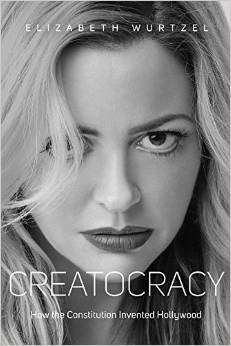
Unknown
Photo by Jason Myers

“There’s no particular reason that the Constitution, which otherwise contains few frills, should bother to make mention of something as luxurious to a nascent nation as intellectual property,” writes Wurtzel.  “And yet, there it is. As such it made America. Because of intellectual property, we live in a democracy of ideas and not a plutocracy of provenance.”

In just about ten thousand or so words, Wurzel flaunts American exceptionalism in both creative and practical inventions with the kind of energy in her writing that Kerouac gave to his love of jazz.   She gets in your face and tells you unequivocally that America is the coolest country in the world and that it has the almost incidental establishment of intellectual property law to thank for that coolness.  She reminds us that implicit in the Progress Clause is the same contagious, unwarranted optimism that created America in the first place. Drawing upon the fact that the nation itself is an improbable, even preposterous, invention, she cites the historical irony that no revolution of such magnitude had ever been fought, let alone won, by a people who had it so good. So, of course that same restlessness would eventually land men on the moon (and bring a car!), invent Rock-n-Roll and the Internet, build the largest military force in the world, and make a motion picture that cost a gazillion dollars just to produce a mediocre melodrama tacked onto an epic recreation of the epic sinking of the Titanic.

In fact, Wurtzel’s example of extolling the scope and audacity of James Cameron’s blockbuster is a pretty good metaphor for why I choose to defend copyright.  Sure, I criticized that film for all the subtle moments of pathos the script forgoes in favor of dime-novel sentimentality. And I have certainly never been a teenage girl who would return to the theater a dozen times to watch Leo sink into the Atlantic. But I agree with Wurtzel that we have reason to celebrate the gall that made that over-hyped, over-budgeted movie because it could have been a disaster, but it worked. And for better or worse, that has been the American story over and over again.

Likewise, it really is kinda cool that the Framers almost haphazardly established the basis for intellectual property while cobbling together a new nation populated by semi-literate and generally unwashed farmers. “… it was a supreme leap of of faith to believe that there would ever be culture in this country …,” writes Wurtzel. And although it is necessary and relevant that we critique law as we might critique Titanic, when that criticism lapses into futile cynicism, we do often forget to have fun. Wurtzel’s enthusiastic little book reminds me that every time I hear or read some high-level, academic, legal theory banging on about natural laws and government-granted monopolies and maximalism and so on, I often want to say, “Dude, whatever. It worked. We totally got Elvis and Ray Charles and Star Wars and the Corvette and, yes, even Google. So, quit being a stick in the mud, and go fix something that isn’t working!”

I often worry that the America envisioned by some of the more extreme intellectual property rights reformers would look more like China, which we might describe as the Elvis impersonator version of a culturally diverse society.  Whether it’s software or handbags or CDs, there’s something fundamentally depressing about a nation filled with so many knockoffs, lacking a system for creating a more diverse bounty of their own cultural works and inventions or even a system for acquiring our works in fair trade. It’s what a market looks like where there are limited moral boundaries like intellectual property or human rights that are tethered to the foundations of free enterprise.  In Creatocracy, Wurtzel celebrates the fact that copyrights and patents make commerce out of intellectual and creative endeavor because commerce is the ultimate democracy.  Yeah, money makes people do bad things sometimes (or more often just lame things), but that’s exactly why our system based on IP is brilliant — because it does the best job of removing both government and aristocracy from the creative process and gives the power to the people. “Here the idea was everyone would buy a ticket or purchase a copy, and voila — fun!  Everyone pays a little and gets back a lot. Culture is as democratic as government. When it comes to taste, the people rule,” she writes.

But I have seen folks suggest on this blog and elsewhere that perhaps patronage or publicly-funded works would be preferable to the intellectual property system we’ve had so far. This view is not only cynical (and really boring), it’s contradictory.  These folks argue that, on the grounds that copyrights are “government-granted monopolies that keep creative works from the people” (which makes no sense on the face of it), they would sooner see a system in which only large corporations, wealthy individuals, or members of Congress sponsor creative taste and/or R&D in this country.  How is that in any way an antidote to the consolidation culture these same critics (and I for that matter) view as socially regressive? These same people have yet to recognize that their anti-copyright, populist, free-for-all has so far made creative works more corporatized and driven popular creators toward patronage-like models to survive.

The Silicon Valley tycoons and their vast PR network love to talk about “permissionless innovation” as though intellectual property were the barrier preventing that innovation.  But their blindness in this regard is why, for all their new-money insouciance, they’re really a bunch of fuddy-duddy corporate wonks. They miss the point that the individual rights granted to inventors and creators is the legal embodiment of permissionless innovation. It is constitutionally guaranteed permission to not ask permission of anyone other than an audience or a customer. It’s why the Dead Kennedy’s got away with saying “Fuck The Man.”  Because The Man, no matter how rich or powerful he may be, can still only buy one ticket relative to an audience of millions of screaming, head-banging fans.

As Wurtzel points out, while American fine arts are something of a carry-over from our cousins across the pond, the breadth and depth of expressions written onto “celluloid and vinyl and acetate” are distinctly American.  And despite the inexorable, so-called progress of these tactile media into drab, invisible ones and zeroes, we should not let that be the reason to starve genius or stifle the quixotic madness that may produce big, daring works just because we can. There’s plenty that American exceptionalism does not get right. We believe our own press and too often confuse our mythology with history. We can’t always tell the difference between reality and a movie, but whether we do the most audaciously noble or the most audaciously terrible thing in reality, it’s worth noting that we always relive, re-contextualize, and reexamine those truths through our movies. “Our movies are America,” writes Wurtzel. And I think she has a point.


Elizabeth Wurtzel is also the author of Prozac Nation and Bitch: In Praise of Difficult Women.

Richard Prince Instagram series reflects digital-age values.

“Of course it’s art,” writes The New Yorker critic Peter Schjeldahl. “… though by a well-worn Warholian formula:  the subjective objectified and the ephemeral iconized, in forms that appear to insult but actually conserve conventions of fine art.”

What Schjeldahl is referring to is a September exhibit at the Gagosian Gallery in New York City by visual artist Richard Prince, who for much of his career has made extensive use of appropriation in his work, though it’s fair to say that many would consider the word work generous in Prince’s case. This exhibit featured 38 images that he re-photographed from Instagram and then ink-jet printed onto canvas in poster size along with fragments of social media comments, emojis, and one comment by the artist himself.  The series has been called “lazy” and “theft” by many, adding to Prince’s infamy among photographers and copyright advocates for continuing to unabashedly use other people’s material without permission.  And last week, those communities again had reason to hate on the artist in blogs, articles, and comment threads responding to the revelation that some of the Instagram canvases were sold at the Frieze Art Fair for up to $100,000 a piece.

No question it’s easy to dislike Richard Prince in this case. Though I feel the vitriol is well covered, I’m happy to jump momentarily on the bandwagon to say that, yes, I think this work is lazy and consistent with other examples of Prince’s disregard for fellow photographers. This of course includes the more serious case in which he got away with appropriating the work of professional photographer Patrick Cariou.  Having said that, though, I do think there’s more to this story than a grabby headline about a rich guy making a pile of money with other people’s Instagram photos.  To that end, it occurs to me to examine this exhibit through the lens of the most common criticisms.

It’s lazy. But is it art?

Apparent laziness or effort on the part of the artist is of little use I think in any conversation about either the social or monetary value of a work. This is in fact a premise I reject on a regular basis on this blog — that the value of any single expression should in any way reflect either the intrinsic or extrinsic cost of production.  If for instance a song moves you, it doesn’t matter if it took the artists who created it six weeks of blood and soul or six hours of beer and pretzels. As audience, our role is to enjoy the song or not; how it came to be isn’t necessarily our business.

Moreover, the history of fine art is full of examples of appropriation, found art, and other expressions that critics both professional and amateur might be tempted to describe as “lazy.” Most notably one thinks of the “Warholian formula” to which Schjeldahl refers, but of course some might express similar disapproval of Jackson Pollack, Marcel Duchamp, or any number of abstract painters, sculptors, and performance artists. But if an exhibit or single work sparks conversation, even makes people angry, then we probably have to concede that the expression is art in the critical sense. And as a technical point, my fellow copyright defenders want the definition of art to be broad and critically neutral. So, I think we should be careful that while assailing Prince’s lack of respect for copyrights in general, we not confuse this with dismissing any work as a non-expression even if we want to call the creator a hack.

It’s certainly true that on the surface, this Instagram series hardly reveals anything we might call work on the part of the artist. The compelling element in each print is after all someone else’s photograph onto which Prince has applied the barest effort and called it his own. It is even a safe bet, given the fact that he is quite wealthy as artists go, that Prince has an assistant or two to do the “heavy lifting” for a project like this. And again this places the exhibit in historical line with the Warhol Factory.  But whether intended or not, I do think Prince has actually done something rather interesting by removing these images from the transient (one might say disposable) platform of social media and forced them to exist at least for a moment as photographs — “Artifying non-art,” as Schjeldahl puts it.

A photographer friend of mine, who also forages in appropriation, says that “photography asks us to hold still,” which is the opposite imperative of social media that demands we keep moving, gorging ourselves, snacking on images all day long. Prince’s use of these Instagram photos may indeed reek of indolence and even shamefulness, but the exhibit itself is also a rather provocative statement about social media and the broader devaluation of photography in the digital age. A good villain in any narrative usually tells us something about a flaw in the hero, and in this sense, the fuck-you-ness of Prince’s choice becomes something of a cautionary tale. It says, “You put these images someplace meaningless and forgettable, but I made them into art.” Peter Schjeldhal calls the series inevitable. If Prince hadn’t done it, somebody else would have, he insists.  And perhaps if a lesser-known artist had done it in some humble presentation, it would trend “cool” on social media. But it was Richard Fucking Prince, and he made a pile of money. And that seems to make all the difference in the world.

The Money (Why does it matter?)

First of all, I think it is important to offer a different perspective on a common theme running through much of the top-line criticism of the Instagram series. Because I think it’s technically misleading to say that this is a story about how a rich guy gets away with copyright infringement to the detriment of the little guy who cannot defend himself. The reality is that in order to sue someone for statutory damages due to infringement of a photograph, the original must be registered with the Copyright Office; and it is almost certain that none of the photographs Prince used (not to mention most of the images on Instagram) are registered. But if one photo were protected and its owner chose to litigate, the fact that Prince is wealthy would only make him a more attractive defendant, not a less attractive one.  It’s always better to sue people who actually have money, so it’s a bit counter-intuitive to suggest that Prince is shielded by his wealth; and it is more accurate to say that he’s shielded by the fact that the photos he used likely offer no path to pursue a claim.  (As a side note, Ellen Seidler at VoxIndie took this story as an example of why we need a Copyright Small Claims Court.)

So, having made that particular distinction about the role of money in this story, I’m still intrigued about its function from an emotional or cultural perspective. What if Prince put up the same show but didn’t sell any of the works?  Immediately, audiences and critics would be forced to judge the exhibit exclusively on its merits or lack thereof, and this might change opinions about it entirely.  Would all of the same people whose photos were stolen suddenly love the exhibit and be flattered because now the artistic statement is more pure, unsullied by commerce?  Certainly, that would be somewhat consistent with the “sharing economy” ethos borne of the digital age.  But a more apt metaphor for turning Instagram images into a physical gallery experience would be if Prince hosted the show for “free” by getting a sponsor to pay him a million bucks. The sponsor could even be Facebook! Would that change anyone’s feeling that Richard Prince is a thief?  If not, then I have to ask why it’s okay for Google, Facebook, Twitter, etc. to do almost exactly the same thing?

Of course another part of the narrative here in which money has a hand is the complaint that Richard Prince gets away with this because he’s Richard Prince.  True.  But welcome to the fine art world. It has always been a rarified environment in which the distinction between genius and charlatan is defined by the chaotic forces of intellect, ego, and wealth. Among those with the resources to pay a hundred thousand dollars for a print, one finds connoisseurs and posers — those who buy according to tastes they’ve developed for themselves, and those who buy according to tastes they’ve let others develop for them. This is nothing new. And this particular brand of commerce will always produce the classic antagonists of the academie and the refusé.   Good luck attempting to parse that. But the reality is that many buyers are investing, hoping their prints will appreciate in value regardless of any particular taste or connection to the work itself. And this means that, yes, Richard Prince gets away with selling his lazy-ass work for that kind of money simply because he is Richard Prince. It was ever thus. C’est la guerre.  Blaming Richard Prince for being Richard Prince is pointless. The question is how the money affects our judgment of him as an intellectual property thief.

Theft (Would this be fair use?)

Although I’ve stated the technical reason why Prince will almost certainly not be sued over any of the works in this collection, the Instagram series still raises the hypothetical question as to whether or not he might effectively make a strong fair use defense in an infringement case.  I’ll stick to my general rule of not offering an inexpert legal argument, especially regarding a case that will never happen.  That said, case law precedent, including Prince v Cariou itself, suggests that the courts could uphold a fair use defense for one of these works, though I certainly think that would be dismaying.  As stated in another post, I believe if fair use doctrine becomes a free-for-all, it ceases to have much meaning as a doctrine and as an important limitation on copyright.

What is interesting from a cultural perspective, though, is to consider the general sensibility about fairness in our times, regardless of any technical understanding of fair use doctrine.  The Internet industry likes to promote the idea of “expanding fair use” because this serves their business model at this time.  And millions of Internet users like the sound of this argument for what I believe are two reasons: the first is that they like the convenience of linking, embedding, copying and pasting without having to worry about infringement; and the second is that so much communication on the Web is produced without any expectation of revenue.

So, I suspect many people favor very broad applications of fair use doctrine as long as it at least appears as though nobody’s making any money.  But when we tell many of these same people, “Hey this wealthy dude just made bank by selling complete strangers’ Instagram pics,” many will say this sounds inherently unfair — as though some tech-age, social compact has been broken.  It’s as though there’s some unspoken rule that says we can steal all we like from one another as long as nobody makes money except the big site owners and the VCs.  There is hypocrisy in the attempt to straddle this particular fence because technically, Richard Prince has done nothing different than Instagram itself. And of course that’s why I think this exhibit that bridges the worlds of social media and traditional fine art is particularly interesting, especially because it’s rude.  Put another way, this exhibit is a manifestation of the kind of copyright paradigm many people are asking for. Creators who buy into the whole “democratization and sharing” narrative should realize it will always be a Richard Prince or a Mark Zuckerberg who will make the money.

I will comment on one of the four factors of fair use here because I believe it may allude to the heart of what many artists and even non-artists find so unfair about this Instagram series.  One of the factors weighed attempts to assess the extent to which a derivative work might threaten the market value of the original.  In this case, such harm could be substantial, particularly given the above statements about commercial value that is tied exclusively to the imprimatur of a famous, pop artist.  Imagine an unknown photographer is trying to break into the market, and along comes Richard Prince, who signs his name to one of this guy’s images and then sells it.  Not only would that be theft in the first place, but it could also render the original photo valueless now that there is a “Richard Prince” version of the same photo in the world.  And that is, at least metaphorically, what Prince has done with the photos in this Instagram series. Not only should that not be considered a fair use in a court of law, but I suspect that on the most instinctive level, it is the reason we are required to hate him.

On @POTUS this Memorial Day

As this Memorial Day marks the end of the week in which President Obama christened the @POTUS handle on Twitter; and the pundits and the halfwits have all weighed in, with observations from the former and racist threats from the latter; I thought I would repost one of the more thoughtful excerpts from former President Dwight D. Eisenhower’s “Cross of Iron” speech from 1956.  Probably no president spoke with more authority on the holistic cost of modern war.  Regardless of your own views on Eisenhower or his warnings against the military-industrial complex, I would ask if anyone thinks these words might inspire any greater introspection doled out 140 characters at a time across the frenetic threads of social media.

“Every gun that is made, every warship launched, every rocket fired signifies, in the final sense, a theft from those who hunger and are not fed, those who are cold and are not clothed. This world in arms is not spending money alone. It is spending the sweat of its laborers, the genius of its scientists, the hopes of its children. The cost of one modern heavy bomber is this: a modern brick school in more than 30 cities. It is two electric power plants, each serving a town of 60,000 population. It is two fine, fully equipped hospitals. It is some fifty miles of concrete pavement. We pay for a single fighter plane with a half million bushels of wheat. We pay for a single destroyer with new homes that could have housed more than 8,000 people. This is, I repeat, the best way of life to be found on the road the world has been taking. This is not a way of life at all, in any true sense. Under the cloud of threatening war, it is humanity hanging from a cross of iron….Is there no other way the world may live?”   – Dwight D. Eisenhower –

There’s nothing particularly wrong with @POTUS on Twitter, and the platform itself is a fine vehicle for distributing links to material worthy of our time and contemplation.  But let’s not ask too much of the individual tweets by any president. At the end of the day, they’re just sound bites that don’t even leave room for grammar.